 Haris
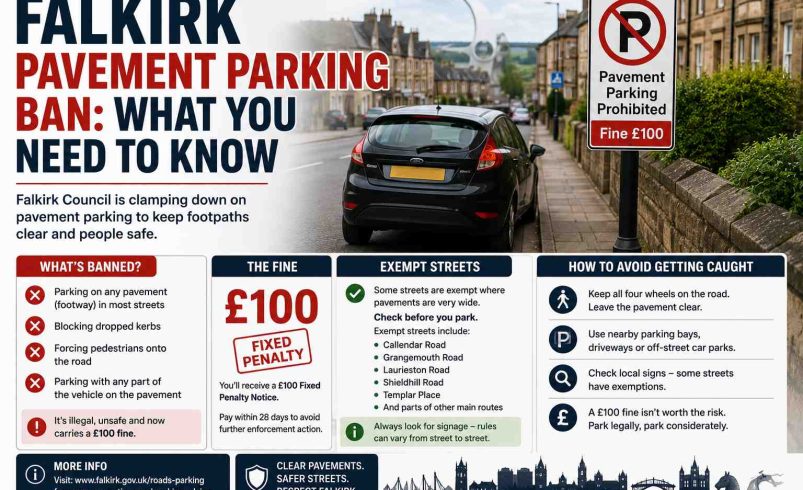
If you’re searching “Falkirk pavement parking ban”, you’ve probably either had a fine or you’re trying to avoid one. The short answer is that Falkirk Council began fully enforcing a ban on pavement parking, double parking and blocking dropped kerbs from 18 August 2025, with a £100 fine for anyone caught breaking the rules. This guide covers exactly what’s banned, how the fine works, which streets are still under review, and how to make sure you’re parking legally.
You’ll find the exact rules, the fine and how to reduce it, which areas are exempt, and an FAQ covering enforcement, appeals and reporting other drivers.
What the Falkirk Pavement Parking Ban Actually Covers
The ban makes it illegal to have one or more wheels of a vehicle on the pavement, according to Falkirk Council’s own guidance. It also covers three related situations that often get lumped in with pavement parking but are worth understanding separately.
- Pavement parking: any part of the vehicle’s wheels resting on the footway, whether or not the driver is present or the engine is running.
- Verge parking: parking on low verges next to roads, which are treated the same as pavements under the rules.
- Blocking dropped kerbs: parking in a way that blocks a dropped kerb used by pedestrians, wheelchair users or people with prams to cross safely.
- Double parking: stopping on the carriageway alongside another parked vehicle in a way that obstructs the road.
The rules apply regardless of whether you’re in the car. A stationary vehicle with the engine running and the driver behind the wheel is still breaking the rules if a wheel is on the pavement.
The Legal Basis for the Ban
The Falkirk pavement parking ban isn’t a local invention. It comes from the Transport (Scotland) Act 2019, which received cross-party support in the Scottish Parliament and gives every Scottish council the power to enforce pavement parking, double parking and dropped kerb restrictions. The relevant national provisions came into force across Scotland on 11 December 2023.
Local authorities then decide their own enforcement timeline, which is why some Scottish councils started earlier than Falkirk. Edinburgh was the first to enforce the rules, issuing fines from 29 January 2024, and had issued over 5,000 penalty notices for footway parking alone by January 2025. Falkirk followed a slower, phased route rather than moving straight to fines.
The Falkirk Pavement Parking Fine
Breaking the rules costs £100, reduced to £50 if you pay within 14 days. This follows the same structure used for other parking penalty charge notices in Scotland, giving drivers a financial incentive to settle quickly rather than dispute or ignore the fine.
[Table: Falkirk pavement parking ban penalty structure showing fine amount and payment window]
| Situation | Amount | Payment window |
| Standard penalty charge notice | £100 | Full amount |
| Early payment discount | £50 | Within 14 days of the notice |
Repeated breaches don’t currently carry an escalated fixed penalty under the published rules, but unpaid fines can progress through standard enforcement and recovery processes if left unpaid.
Falkirk’s Timeline: How the Ban Was Rolled Out
Falkirk Council didn’t move straight from no rules to fines overnight. From 7 May 2024, the council began issuing advisory notices to warn drivers about the coming changes, distributing around 1,800 of these notices over the following months to raise awareness before enforcement began.
Alongside the awareness campaign, the council assessed all 2,360 roads across the Falkirk area to work out which streets might genuinely need an exemption because of limited parking alternatives. That assessment identified 21 streets under consideration for exemption, including Netherby Road in Airth and Bridgeness Lane in Bo’ness, where enforcement was delayed until the review was complete.
Full enforcement, with fines actually being issued, started on 18 August 2025.
Which Falkirk Streets Are Exempt
Not every street in Falkirk is treated identically. Where the council’s assessment found genuinely limited parking alternatives, specific streets were flagged for possible exemption rather than blanket enforcement.
If you live on or regularly park on a street that seems to allow pavement parking in practice, don’t assume that’s a permanent exemption. Falkirk Council’s assessments are ongoing for the flagged locations, and enforcement can begin on a previously exempt street once a review concludes. Check the council’s website directly for the current list before relying on a street’s past treatment.
Who Doesn’t Have to Follow the Rules
A small number of exemptions apply regardless of location. Emergency service vehicles, including Police Scotland, ambulance, fire and coastguard vehicles, are excluded when responding to an incident. Vehicles assisting at an accident or breakdown are also excluded from penalties while carrying out that work.
Taxis are explicitly not exempt. Falkirk Council’s guidance is clear that taxi drivers are expected to park or wait correctly at all times, the same as any other driver.
What to Do If You’re Blocked by Pavement Parking
If a parked vehicle is blocking your path on a pavement, the reporting route depends on exactly how it’s parked. If one or more wheels are on the footway, that falls under the pavement parking prohibition and Falkirk Council can enforce it directly.
If the vehicle is fully on the road but still causing an obstruction, for example blocking a narrow pavement without any wheels actually on it, that’s classed as an obstruction rather than a pavement parking breach, and it should be reported to Police Scotland on 101, their non-emergency number, rather than to the council.
Mistakes Drivers Make Under the New Rules
A handful of misunderstandings account for most of the fines issued so far.
Assuming a quick stop doesn’t count catches people out often. The rules apply to stationary vehicles whether or not the driver is present and whether or not the engine is running, so nipping into a shop with two wheels on the kerb still breaches the ban.
Confusing “no wheels on the pavement” with “leaving enough room” is another common error. Even if a vehicle parked fully on the carriageway leaves what feels like enough space for pedestrians, that’s a matter for an obstruction report to Police Scotland, not something the pavement parking rules themselves are designed to police.
Assuming a previously tolerated street is still exempt causes confusion too. With 21 streets still under review as of the ban’s introduction, a street where pavement parking has always happened without comment isn’t necessarily one of the confirmed exemptions.
FAQ
Q: When did the Falkirk pavement parking ban start?
Full enforcement, with fines being issued, began on 18 August 2025. Before that, Falkirk Council ran an awareness period from 7 May 2024, issuing advisory notices rather than fines to give drivers time to adjust.
Q: How much is the fine for pavement parking in Falkirk?
The fine is £100, reduced to £50 if paid within 14 days of the penalty charge notice. This matches the standard structure used for parking penalties elsewhere in Scotland.
Q: Are there any exempt streets in Falkirk?
Yes, 21 streets were identified for possible exemption following an assessment of all 2,360 roads across the Falkirk Council area, including Netherby Road in Airth and Bridgeness Lane in Bo’ness. These remain under review, so check Falkirk Council’s website for the current status rather than assuming a street is permanently exempt.
Q: Can taxis park on pavements in Falkirk?
No, taxis are not exempt from the pavement parking ban. Falkirk Council’s guidance states taxi drivers are expected to park or wait correctly at all times, the same as any other motorist.
Q: What counts as pavement parking under the new rules?
Any vehicle with one or more wheels on the footway counts as pavement parking, regardless of whether the driver is present or the engine is running. The same rules also cover parking on low verges next to roads, blocking dropped kerbs, and double parking on the carriageway.
Q: Who is exempt from the pavement parking ban?
Emergency service vehicles (police, ambulance, fire and coastguard) are exempt when responding to an incident, as are vehicles assisting at an accident or breakdown while carrying out that work. No other category of driver, including taxi drivers, is exempt.
Q: What should I do if a car is blocking the pavement but not parked on it?
Report it to Police Scotland on 101, their non-emergency number, since this counts as an obstruction rather than a pavement parking breach if no wheels are actually on the footway. Falkirk Council can only enforce the pavement parking rules when a wheel is on the pavement itself.
Q: Is the Falkirk ban part of a wider Scotland-wide change?
Yes, it stems from the Transport (Scotland) Act 2019, which allows every Scottish council to enforce pavement parking, dropped kerb and double parking restrictions. Different councils have enforced it on different timelines, with Edinburgh starting first in January 2024 and other areas, including Fife, following through 2025.