 Haris
Haris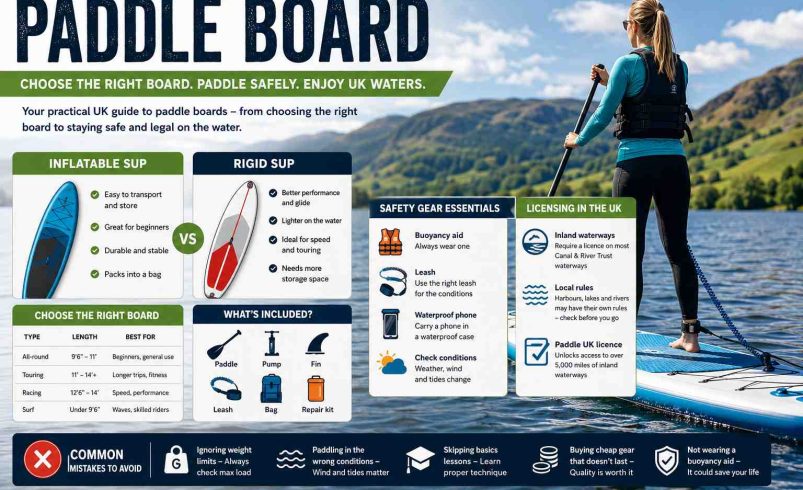
Finding a suitable paddle board for UK conditions means looking past Instagram aesthetics to focus on local waterways, storage realities and genuine safety requirements. The best paddle board for British rivers, canals and coastal spots depends entirely on where you will actually use it rather than what looks good online. Inflatable models dominate the UK market because they survive rocky riverbeds and fit in car boots, but rigid boards still outperform them in specific scenarios . This guide covers current pricing tiers, mandatory safety equipment under UK law, and the licensing rules that vary significantly between England, Scotland, Wales and Northern Ireland. You will also learn which common mistakes waste money or create dangerous situations on the water.
Inflatable Versus Rigid Boards for UK Waters
Inflatable SUPs account for over 90% of UK sales due to practical logistics rather than performance superiority . Modern drop-stitch construction allows quality inflatables to reach 15-25 PSI rigidity comparable to entry-level hard boards when properly inflated . They withstand contact with weirs, shingle beaches and canal locks without structural damage that would destroy composite shells . Storage convenience matters enormously for flat-dwelling urban paddlers lacking garage space.
When Rigid Boards Justify the Hassle
Hard boards remain superior for racing, surfing large waves or frequent saltwater use where UV degradation affects PVC over time . Epoxy and carbon fibre constructions offer better glide efficiency and tracking straightness in open water . However, roof rack transport requirements and fragile fins limit their practicality for casual recreational users . Consider rigid boards only if you have dedicated storage, regular access to suitable launch points and specific performance goals beyond general fitness paddling . Most UK beginners benefit from starting inflatable and upgrading later based on actual usage patterns rather than aspirational purchases.
| Feature | Inflatable SUP | Rigid SUP |
| Price Range (UK) | £250 – £800 | £600 – £2,500+ |
| Storage Required | Car boot sized | Garage or roof rack |
| Durability (Rocks/Shingle) | High | Low to Medium |
| Performance (Glide/Speed) | Good | Excellent |
| Setup Time | 10–15 minutes | None |
| Best For | Beginners, Rivers, Travel | Racing, Surfing, Open Water |
Current UK Pricing and Hidden Costs
Budget inflatable boards between £250 and £400 typically use single-layer PVC with basic accessories . These suffice for calm lake paddling but flex noticeably at lower pressures and lack durability for regular river use . Mid-range options from £450 to £700 feature dual-layer or fusion-drop-stitch construction allowing higher PSI ratings and better stiffness-to-weight ratios . Brands like Red Paddle Co, Gladiator and Loco London dominate this segment with UK-specific warranties and repair support.
Essential Accessories Beyond the Bundle
First-time buyers frequently underestimate essential accessory expenses beyond the packaged bundle. A reliable electric pump costs £80 to £150 separately, as included manual pumps make reaching optimal pressure exhausting and time-consuming . Personal flotation devices meeting UK standards start around £40 for belt-pack inflatables suitable for competent swimmers . Leashes are legally required on many UK waters and cost £25 to £50 depending on type . Budget realistically £600 to £900 total for a safe, functional setup rather than assuming package deals cover everything needed.
UK Safety Laws and Mandatory Equipment
The Royal National Lifeboat Institution reports paddle boarding incidents increased by 47% between 2020 and 2023, prompting stricter safety messaging . While no national licence exists for recreational SUP, specific waterways enforce mandatory equipment requirements through local bylaws . The RNLI and British Canoeing jointly recommend wearing a leash appropriate to your environment plus a buoyancy aid or lifejacket at all times . Cold water shock remains the primary killer in UK waters, making thermal protection vital even during summer months.
Environment-Specific Leash Requirements
Leash choice directly impacts survival chances depending on water type. Straight ankle leashes suit flat water but create dangerous drag in moving currents where quick-release waist belts prevent entrapment against obstacles . Coiled leashes reduce drag on rivers but can tangle in vegetation . Never use surf-style ankle leashes in tidal or flowing water where snagging risks drowning . Check local navigation authority rules before each session, as Environment Agency, Canal & River Trust and harbour authorities maintain different requirements . Ignorance of site-specific regulations does not exempt paddlers from enforcement action.
Licensing and Access Rights Across the UK
Waterway access rules differ substantially between devolved nations and individual navigation authorities. In England and Wales, British Canoeing membership (£45 annually) provides access to Canal & River Trust and Environment Agency waterways without separate licences . Scotland operates under statutory public access rights via the Land Reform (Scotland) Act 2003, meaning no licence is needed for most inland waters . Northern Ireland requires separate permission from landowners or Loughs Agency permits for specific loughs and rivers . Always verify local requirements before visiting unfamiliar locations as rules change periodically.
Coastal and Harbour Authority Regulations
Tidal waters generally allow free navigation except within commercial port boundaries where harbour master permission may be required . Some estuaries and bays impose seasonal restrictions to protect wildlife or manage congestion . Launching from private beaches demands landowner consent regardless of water access rights . Commercial operators need additional licensing beyond recreational permissions . Contact relevant harbour authorities or coastguard stations directly when planning coastal trips to confirm current restrictions.
Common Beginner Mistakes to Avoid
Under-inflation causes more performance complaints than any other factor among new UK paddle board owners . Most boards require 15 PSI minimum for adequate rigidity, yet many stop pumping at 10-12 PSI when resistance increases . Invest in a gauge-equipped pump and verify pressure numerically rather than judging by feel . Another frequent error involves launching without checking tide tables or weather forecasts specifically for your location . Offshore winds push paddlers out to sea faster than they can paddle back, accounting for numerous RNLI callouts annually.
Storage and Maintenance Oversights
Leaving inflated boards in direct sunlight causes internal air expansion that can exceed seam tolerances and cause delamination . Always deflate slightly or store shaded during hot weather . Saltwater exposure demands thorough rinsing after every coastal session to prevent valve corrosion and material degradation . Neglecting fin box cleaning allows sand accumulation that damages threads and compromises future installations . Simple maintenance habits extend board lifespan significantly compared to reactive repairs after failure occurs.
Where to Buy Safely in the UK
Specialist UK retailers provide post-purchase support that marketplace sellers cannot match. Shops like Cornish Point Boards, Wetsuit Outlet and various independent centres offer warranty handling, repair services and expert fitting advice . Buying secondhand requires careful inspection for hidden damage including creases indicating internal baffle failure or valve leaks . Test inflation to full PSI before purchase and check serial numbers against manufacturer databases for theft or recall status . Avoid suspiciously cheap imports lacking UKCA marking or verifiable safety testing documentation.
Renting Before Committing
Hiring equipment for several sessions across different conditions reveals preferences that online research cannot predict . Many UK centres offer try-before-you-buy schemes deducting rental fees from subsequent purchases . Rental fleets typically stock proven mid-range models representing sensible value benchmarks . Instructors identify technique flaws and equipment mismatches early, preventing costly wrong purchases . Spending £150 on lessons and rentals saves thousands on unsuitable gear gathering dust in storage.
Frequently Asked Questions About Paddle Boards
Q: Do I need a licence to paddle board in the UK?
No national licence exists for recreational paddle boarding on most UK waters . However, specific locations like certain reservoirs, harbours or commercial waterways may require permits or membership . Canal & River Trust waters in England and Wales require either a licence or British Canoeing membership . Scotland’s Land Reform Act grants broad public access rights without licensing . Always check local navigation authority websites before visiting unfamiliar locations as rules vary significantly between nations.
Q: What size paddle board should a beginner get?
Most UK beginners suit boards 10’6″ to 11′ long and 32″ to 34″ wide for stability versus portability balance . Wider boards offer greater initial stability but sacrifice glide efficiency and increase wind resistance . Weight capacity should exceed your body weight by at least 20kg to accommodate gear and maintain performance . Height matters less than volume distribution relative to intended use conditions . Try multiple sizes through rental centres before purchasing to confirm personal preference.
Q: How long does an inflatable paddle board last?
Quality UK-spec inflatable SUPs typically last 5 to 10 years with proper care and moderate use . Single-layer budget boards may degrade within 2-3 seasons due to UV exposure and abrasion . Dual-layer and fusion-construction models resist wear significantly better . Lifespan depends heavily on storage conditions, maintenance frequency and usage environments . Coastal saltwater use accelerates deterioration compared to freshwater inland paddling . Regular inspection and timely repairs extend service life considerably.
Q: Is paddle boarding safe in cold UK water?
Cold water shock poses serious risk year-round in UK waters where temperatures rarely exceed 18°C even in summer . Wearing appropriate wetsuits or drysuits prevents incapacitation from sudden immersion . Acclimatisation periods and gradual entry reduce shock severity . Never paddle alone in cold conditions without telling someone your planned route and return time . Carry waterproof communication devices rated for marine use . Assume all UK water is cold enough to kill regardless of air temperature.
Q: Can I take my paddle board on public transport?
Transport policies vary significantly between operators and routes. National Rail generally permits boards up to 2 metres length outside peak hours when bagged appropriately . TfL buses prohibit SUPs entirely while some Tube lines allow folded inflatables off-peak . Always check specific operator conditions before travelling as staff discretion applies . Inflatable boards packed in backpacks face fewer restrictions than rigid alternatives . Plan journeys avoiding rush hours to minimise refusal risk.
Q: What’s the difference between SUP and paddle boarding?
SUP stands for Stand Up Paddleboard or Stand Up Paddleboarding depending on context . Both terms refer identically to the same activity and equipment in UK usage . Marketing materials sometimes distinguish SUP as sport-focused versus recreational paddle boarding, but no technical difference exists . Search results and retailer categorisations treat them interchangeably . Use whichever term feels natural without worrying about correctness
Q: How do I transport a paddle board without a roof rack?
Inflatable SUPs fit inside most estate cars and SUVs when deflated and rolled . Smaller vehicles may require folding rear seats or external straps for longer packages . Rigid boards demand roof racks, trailers or specialist carriers exceeding vehicle dimensions . Public transport offers limited viability except for compact inflatables during off-peak times . Consider rental storage near frequented waterways if home transport proves impractical . Factor transport logistics into purchase decisions alongside performance characteristics.
Q: Are cheap Amazon paddle boards worth buying?
Ultra-cheap marketplace boards below £200 frequently lack safety certifications and durable construction . Single-layer PVC with poor glue adhesion risks catastrophic failure mid-water . Included accessories often fail prematurely requiring immediate replacement . Warranty claims prove difficult without UK-based support channels . Spending £300+ from reputable UK retailers provides verified safety standards and after-sales service . False economy risks both financial loss and physical danger.