Swimming Pool: Costs, Rules and Where to Swim in the UK
- August 18, 2026
- 0
Search for “swimming pool” and you’re probably after one of two things: somewhere to swim this week, or a straight answer on what it costs to put one
Search for “swimming pool” and you’re probably after one of two things: somewhere to swim this week, or a straight answer on what it costs to put one
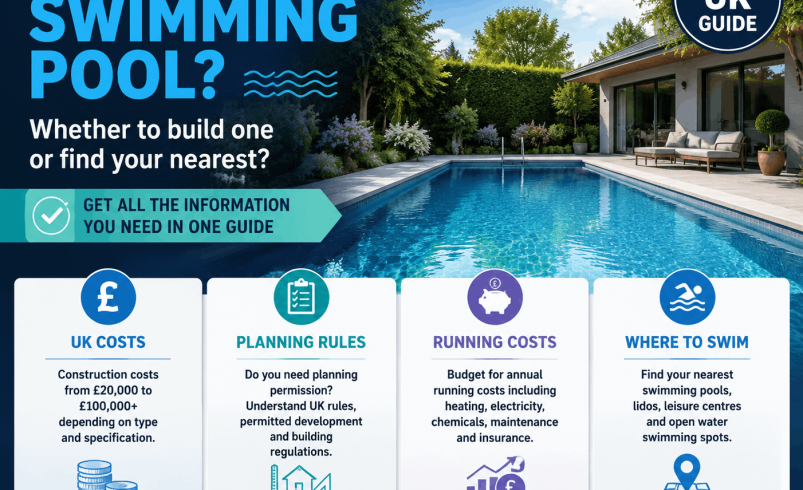
Search for “swimming pool” and you’re probably after one of two things: somewhere to swim this week, or a straight answer on what it costs to put one in your own garden. This guide covers both. Public pools in the UK are easiest to find through Swim England’s postcode locator, while a private swimming pool starts at around £5,000 for a basic above-ground model and climbs well past £100,000 for a custom inground design.
Below you’ll find where to swim locally, what different pool types cost to build and run, the planning rules that actually apply in the UK, and the safety points that get missed in most guides.
Two very different searches sit under this one term. Some people want a place to swim today: a leisure centre, a lido, or a hotel pool nearby. Others are researching a home installation and want realistic costs before they call a contractor.
Both are covered here, but they need different information, so the sections below are split accordingly. If you already know which one applies to you, jump straight to the relevant part using the headings.
The UK has hundreds of public pools, from council-run leisure centres to open-air lidos, and coverage varies a lot by area. A few routes reliably turn up what’s nearby.
Swim England, the sport’s national governing body, runs a free Poolfinder tool that covers England, Scotland and Wales. Enter your postcode and it lists nearby pools along with clubs for diving, water polo, synchronised swimming and disability swimming. It’s the most complete single directory currently available.
Large operators such as Better run more than 100 pools across the UK, offering public swim sessions, lessons and fitness-focused lane swimming alongside membership options. Council-run centres, often operated under contract by companies like these, are usually the cheapest way to swim regularly, with pay-as-you-go and membership pricing that varies by local authority. [Table: comparison of typical UK public pool access options, showing provider type, pricing model and typical facilities]
Outdoor pools, known in Britain as lidos, have seen a revival in recent years. Independent trackers have counted more than 160 outdoor pools and lidos across England, Wales, Scotland and Northern Ireland, ranging from heated art deco lidos to unheated sea pools and reservoirs. Not all are open year-round, so check the specific site’s season before travelling. [Image: photo of a UK outdoor lido — use royalty-free image from Unsplash or Pexels]
Costs vary enormously depending on the type of pool, its size, and whether it’s indoors or outdoors. Trade quote platforms show a wide spread, so treat any single “average” figure with some caution and get several like-for-like quotes before committing.
| Pool type | Typical installed cost | Notes |
| Above-ground | £5,000 to £10,000 | No excavation needed; cheapest route to a garden pool |
| Inground fibreglass | £30,000 to £85,000 | Faster to install than concrete; fixed shell sizes |
| Inground concrete or liner | £30,000 to £110,000+ | More design flexibility; longer build time |
| Custom concrete with tiling or overflow edge | £110,000 to £250,000+ | Reserved for larger, highly specified projects |
| Indoor pool, including the building to house it | £85,000 to £220,000+ | Costs rise sharply once a new structure is needed |
Build time also varies. A straightforward outdoor installation typically takes 3 to 8 weeks, while indoor pools requiring a new structure take considerably longer once groundwork, the building shell and services are factored in. Labour costs in London and the South East tend to run higher than the rest of the country, so location affects the final price as much as the pool itself.
For most UK homes, an outdoor domestic pool is treated as permitted development under the Planning Portal’s guidance for England, meaning it doesn’t need a planning application. It’s classed as incidental to enjoying the house, provided it stays within set limits.
The main limit to watch is that all outbuildings and structures on your property, pools included, can’t cover more than 50% of the land around the original house. Indoor pools are usually built as an outbuilding too, so the same permitted development rules generally apply, though building regulations covering ventilation and structure still have to be met.
You’re more likely to need formal permission if any of the following apply:
This guidance reflects the rules in England. Scotland, Wales and Northern Ireland run their own planning systems with different permitted development limits, so check with your local planning authority before you start digging, particularly for anything beyond a simple garden pool.
Building the pool is only the first cost. Ongoing maintenance, chemicals and energy add up, and this is where a lot of first-time owners underestimate their budget.
Pool pumps generally need to run for 8 to 12 hours a day to keep water properly circulated and filtered, with the filter itself backwashed or cleaned on the schedule the manufacturer recommends. Running the pump during off-peak electricity hours can reduce the cost, particularly if you’re on a variable-rate tariff.
Regular testing keeps chlorine and pH levels within a safe range, using either test strips or a digital meter. Owners typically replace around 10 to 20% of the pool’s total water every one to two years to stop dissolved solids building up, on top of routine top-ups for evaporation.
Total running costs for a private UK pool typically fall between £1,500 and £5,000 a year, covering chemicals, electricity for the pump and heating, and routine servicing. Chemicals alone tend to cost around £650 a year for a standard-sized pool, with the rest made up of energy and any professional maintenance visits. Energy prices change regularly, so check your current tariff rather than relying on a fixed figure when budgeting.
One thing most guides skip: unlike countries such as Australia and France, the UK has no legal requirement for private domestic pools to be fenced. According to SPATA, the UK trade body for the swimming pool and hot tub industry, this is a deliberate position, since drowning rates in UK domestic pools are low enough that the government, on RoSPA’s advice, hasn’t introduced fencing legislation.
That doesn’t mean fencing isn’t worth having. RoSPA continues to recommend layered safety measures for pools with young children nearby, including a secure barrier, self-closing gates, and never leaving toys floating in or around the water, since these tend to draw toddlers back to the pool unsupervised.
Public and commercial pools are a different matter. Operators must comply with the Health and Safety at Work Act 1974 and the associated guidance covering pool safety, which includes carrying out a suitable risk assessment and providing appropriate equipment such as hoists for disabled access.
Q: How much does an average swimming pool cost in the UK? There’s no single reliable average, since pool costs depend heavily on type and size. An above-ground pool starts around £5,000 to £10,000, while an inground pool typically runs from £30,000 to over £100,000, and a custom indoor pool with its own building can exceed £150,000.
Q: Do I need planning permission for a swimming pool? Usually not, if it’s an outdoor pool at a standard residential property in England, since this falls under permitted development. You’re more likely to need permission if your home is listed, in a conservation area, subject to an Article 4 direction, or if the pool would take total outbuilding coverage past 50% of your garden.
Q: How do I find my nearest public swimming pool? Swim England’s Poolfinder tool covers England, Scotland and Wales and lets you search by postcode. Large operators like Better also have their own centre locators, and independent lido trackers cover outdoor pools specifically.
Q: How long can I keep a swimming pool pump running? Most pool pumps run for 8 to 12 hours a day to keep the water properly filtered and circulated. Running it in one or two longer stretches rather than constantly is generally fine, as long as the total daily runtime is met.
Q: Is a fence legally required around a private swimming pool in the UK? No. The UK has no legislation requiring fencing around domestic swimming pools, unlike countries such as Australia. RoSPA still recommends a secure barrier and self-closing gate as good practice, particularly where young children have access to the garden.
Q: What’s the cheapest way to add a swimming pool to a UK garden? An above-ground pool is the lowest-cost option, typically £5,000 to £10,000 fully installed, since it avoids the groundwork and excavation costs that make inground pools more expensive.
Q: How often should I test swimming pool water? Regularly, ideally several times a week during the swimming season, to keep chlorine and pH within a safe range. Digital meters or test strips both work, and water should also be tested after heavy rain or after the pool has had a lot of use.
Q: Are lidos free to use? No, most UK lidos charge an entry fee, similar to a leisure centre pool, though prices and any concessions vary by site and local authority. A small number of outdoor swimming spots, such as some sea pools and natural sites, have no charge at all.
Q: How much does it cost to run a swimming pool per year? Typically £1,500 to £5,000 a year, covering chemicals, pump electricity, heating and routine maintenance. The exact figure depends on pool size, whether it’s heated, and current energy prices, so check your own tariff when budgeting.
Q: Can I build an indoor swimming pool without planning permission? Often yes, since an indoor pool is usually classed as an outbuilding and can fall under the same permitted development rights as an outdoor one. Building regulations still apply, covering ventilation and structural standards, and larger structures are more likely to need a formal application.