Death Notices NI: Where to Look and What They Cost
- August 18, 2026
- 0
If you’re typing “death notices NI” into Google, you’re usually trying to do one of three things: find out when a funeral is happening, place a notice for
If you’re typing “death notices NI” into Google, you’re usually trying to do one of three things: find out when a funeral is happening, place a notice for
If you’re typing “death notices NI” into Google, you’re usually trying to do one of three things: find out when a funeral is happening, place a notice for someone you’ve lost, or work out what to do after a death in the family. This guide answers all three. You’ll find the main places Northern Ireland’s death notices are published, what it costs to place one, how death registration fits in, and what to do once the notice is sorted.
A death notice is a short, usually paid, announcement that someone has died. It states the person’s name, sometimes their age and address, and the funeral arrangements: where they’re resting, the service time, and burial or cremation details.
It’s not the same as a death certificate, which is a legal document issued after registration, and it’s not the same as an obituary, which is a longer piece written about the person’s life. Most searches for “death notices NI” are really looking for one of two things: a specific notice for someone who has died, or general guidance on placing one. [Image: photo of a hand holding an order of service — use royalty-free image from Unsplash or Pexels]
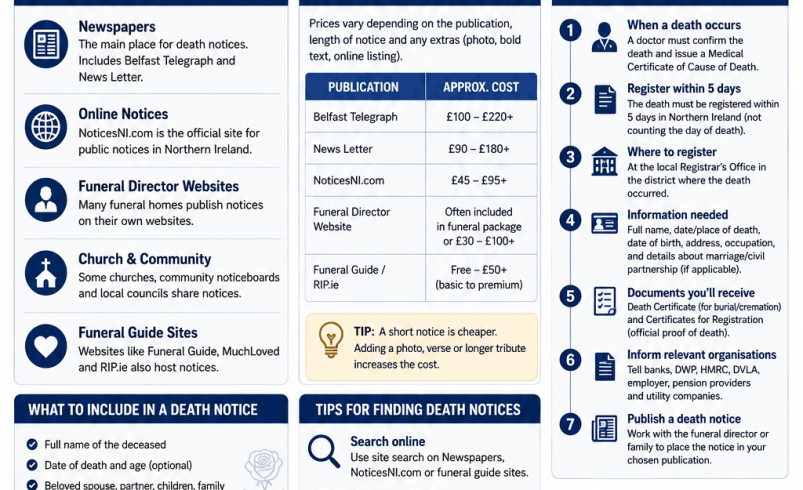
There’s no single official NI death notices website. Notices are spread across newspapers, dedicated funeral sites, and individual funeral director pages. Here’s where to look, in order of how widely each one is used.
Funeral Times is the main dedicated funeral notice site for Northern Ireland. It lets you filter by county, including Belfast, Antrim, Armagh, Down, Fermanagh, Derry/Londonderry and Tyrone, and it’s updated several times a day. Notices usually include the date of death, place, family details, and funeral or Requiem Mass timings. It’s free to browse.
The Belfast Telegraph publishes family and death notices in print and online through its classifieds section. If the person was well known locally, the paper’s editorial team may also run a full obituary separately from the paid notice. Notices booked through the paper typically appear online a short time after the print edition, though you should check current timings and rates directly with the paper, as these change.
Alongside the Belfast Telegraph, these are the two other main daily papers carrying death and funeral notices for Northern Ireland. Coverage tends to reflect readership: the Irish News is read more widely in nationalist areas, and the News Letter in unionist ones, though neither is exclusive. Checking more than one paper gives you a fuller picture, especially outside greater Belfast.
Most NI funeral directors, from large firms to small local ones, list current funeral notices on their own websites. This is often the fastest way to get the exact time and address of a specific funeral, particularly in smaller towns where the family has used one director throughout. [Table: comparison of the main NI death notice sources, showing coverage area, cost to browse, and update frequency]
RIP.ie is the best-known death notices site on the island of Ireland, but it’s based in the Republic and notices can only be submitted by a funeral director, not by a family member directly. It carries some Northern Ireland notices, particularly for border counties, but it isn’t a reliable primary source for NI-wide coverage. Treat it as a supplement to Funeral Times and the local papers, not a replacement.
| Source | Coverage | Cost to browse | Who can submit |
| Funeral Times | Northern Ireland-wide, by county | Free | Funeral directors and families |
| Belfast Telegraph | NI-wide, strongest in Belfast | Free online, notices are paid to place | Families, via the paper or a funeral director |
| Irish News / News Letter | NI-wide | Free online, notices are paid to place | Families, via the paper or a funeral director |
| Funeral director websites | Local to that director’s area | Free | The director, on the family’s behalf |
| RIP.ie | Republic of Ireland, some NI border areas | Free | Funeral directors only |
Costs vary by outlet, length, and whether you want a photograph. As a rough guide, a standard notice in a local Northern Ireland newspaper runs from around £100 to £150, based on estimates from funeral notice services. National UK papers charge considerably more, often £200 to £500, and are only worth considering if the person was widely known outside Northern Ireland.
Prices change regularly and vary between publications, so confirm the current rate and deadline directly with the newspaper or funeral director before booking. As an example of how these fees shift, RIP.ie in the Republic of Ireland introduced a €100 charge per notice from January, having previously been free, which shows how much this can vary year to year even on well-established sites.
Funeral Times and most funeral director websites don’t charge families directly. The funeral director typically arranges the notice as part of their overall service, so ask them what’s included before assuming there’s a separate fee.
Placing a notice is separate from registering the death, and families sometimes mix the two up. Registration is a legal requirement and has to happen before certain steps, such as the funeral, can go ahead.
A death in Northern Ireland must be registered within 5 days, at any district registration office, not only the one covering where the person lived. Registration is handled through the General Register Office for Northern Ireland (GRONI). You can register if you’re a relative of the deceased, someone present at the death, the person arranging the funeral, or the executor or administrator of the estate.
The doctor or hospital sends the Medical Certificate of Cause of Death electronically to GRONI, which forwards it to the correct registration office. If the death was sudden, unexpected, or the person hadn’t seen a doctor in the 28 days before they died, it may be referred to the coroner first, and registration can’t go ahead until that’s resolved.
You can buy a certified copy of the death certificate at the time of registration for £8 per copy. If you need copies later, ordering online through the nidirect website costs £15 for the first copy and £8 for each additional copy bought at the same time. Banks, insurers, solicitors and pension providers will usually each want their own original, so it’s worth ordering several at registration rather than paying more per copy later.
One thing that catches families out is that Tell Us Once, the UK-wide service that lets you report a death to several government departments in one go, isn’t available in Northern Ireland. That means each organisation has to be contacted separately, including:
Gathering several copies of the death certificate before you start these calls saves you having to reorder mid-way through.
Q: What is a death notice NI? A death notice NI is a short public announcement, usually paid for, that someone in Northern Ireland has died. It typically gives the person’s name, sometimes their age, and the funeral or service details. It’s different from a death certificate, which is a legal document, and from an obituary, which is a longer article about the person’s life.
Q: Where can I find recent death notices in Northern Ireland? Funeral Times is the main dedicated site, searchable by county and updated several times daily. The Belfast Telegraph, Irish News and News Letter also carry notices in print and online, and most funeral director websites list current notices for funerals they’re handling.
Q: How much does it cost to place a death notice in NI? A standard notice in a local NI newspaper typically costs £100 to £150, while national papers charge more, often £200 to £500. Sites like Funeral Times usually don’t charge families directly, since the funeral director arranges the listing as part of their service. Always confirm the current price with the outlet before booking.
Q: Is Funeral Times free to use? Yes, browsing Funeral Times to search for a funeral notice or check timings is free. Funeral directors typically handle submitting notices on the family’s behalf as part of their overall service.
Q: How do I find out the exact time of a funeral in NI? Check the notice on Funeral Times, the relevant funeral director’s website, or the newspaper the family used. These usually list the resting place, service time and location, and burial or cremation details.
Q: Do I need to register the death before I can place a notice? Not necessarily. Many families place a notice before formal registration is complete, particularly to announce funeral arrangements. However, registration must happen within 5 days regardless, and the funeral itself generally can’t proceed without the certificate the registrar issues.
Q: How long do I have to register a death in Northern Ireland? You have 5 days from the date of death, unless the case has been referred to the coroner, in which case registration waits until that investigation concludes.
Q: Can I submit a death notice to RIP.ie for someone in Northern Ireland? Only through a funeral director, not directly as a family member, and RIP.ie’s core coverage is the Republic of Ireland. For reliable NI-wide coverage, use Funeral Times or the main NI newspapers instead.
Q: What’s the difference between a death notice and an obituary? A death notice is a brief, paid announcement giving the practical details of the death and funeral. An obituary is a longer piece, often written by a newspaper’s editorial team or the family, that summarises the person’s life, career and character.
Q: Is Tell Us Once available in Northern Ireland? No. Tell Us Once operates in England, Scotland and Wales but not in Northern Ireland, so each organisation, including HMRC, the Department for Communities, DVLA and the Passport Office, has to be contacted separately.